You can recruit financial advisors in-house, without a search firm, by running a repeatable desk: define the advisor you want, work a call list that stays current, prioritize who to contact next, follow a steady outreach cadence, and track every conversation in one recruiting pipeline. You own the relationships, the process, and the cost, rather than depending on a recruiter's queue and a fee that scales with the producer you most want.
Many firms still use a search firm for a hard-to-fill seat or a team lift-out, and that can be the right call. This guide is for RIA, hybrid, IBD, and OSJ leaders who want in-house to be the default path, and who want to know when to bring a recruiter in.
Why is in-house recruiting a real option now?
Three things have changed the math for firms that recruit advisors themselves.
Independence appeals to many advisors. Cerulli's U.S. Broker/Dealer Marketplace 2025 research says advisors are drawn to independent models for higher payout (91%), the ability to build financial value in an independent business (75%), and greater autonomy (73%). If your firm offers those things, you are not cold-calling with nothing to say.
Independent RIAs have been adding advisors. In a Cerulli analysis reported by Financial Planning in November 2023, advisors at independent RIAs grew at a 5.2% compound annual rate over the prior decade, while the number of independent RIA firms grew at 2.4%. Firms may be competing for the same advisors.
Hiring demand is high. Schwab's 2025 RIA Benchmarking Study, as reported by InvestmentNews, says the RIA industry will need to add over 70,000 new staff over the next five years. That figure covers staff in every role, not only advisors.
Then there is cost. Third-party recruiters typically charge 8-12% of an advisor's trailing-12-month (T12) production per placement. On a $500K producer, that is roughly $40,000 to $60,000 for one hire, and the fee grows with the advisor you most want. For the full payback math, see The Real Cost of Recruiting a Financial Advisor.
In-house recruiting flips the ownership model. Your team sources, qualifies, and closes. The relationships stay on your books. Your cost is mostly time plus tools, not a per-placement cut of production. That only works if three things are true: you have a list that stays current, a pipeline built for recruiting (not client households), and a way to decide who to call next.
How do you recruit financial advisors in-house, step by step?
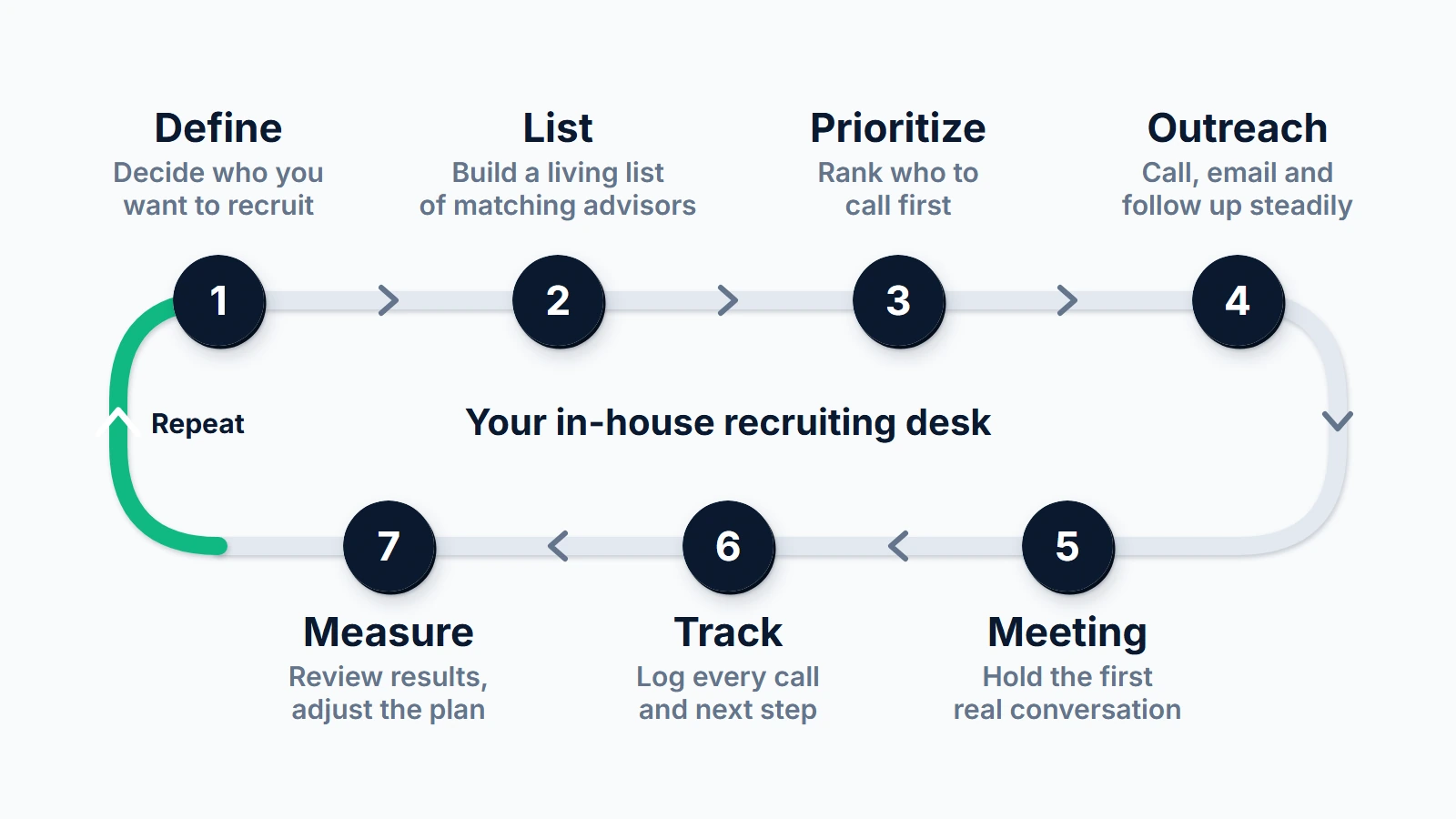
Think of it as seven repeatable steps. Each one is short; the discipline is doing all seven every week.
- Define the ideal recruit. Write the hire like a brief, not a job post: channel and model fit, the production band you can support, geography you can supervise, practice shape, and non-negotiables. If two people on your team would not shortlist the same names, the brief is too loose.
- Work a living call list. A static spreadsheet ages fast. Phones change, firms change, and someone who looked like a fit last quarter may not be callable this quarter. The list needs coverage that matches your brief, contact paths you can use, and firm, tenure, and credential context before the first call. Our guide to building a financial advisor call list covers what separates a usable list from a stale one.
- Prioritize who to contact next. The job is a ranked short list for this week, not more names. Weigh fit against your brief, firm and advisor movement, tenure patterns, markets you have not worked, and where each conversation sits in your pipeline. Treat signals as hypotheses you test on the call, never guarantees that someone wants to move.
- Run a simple outreach cadence. Week one: a call and a short email. Week two: a second touch with a specific reason, such as fit or a timely market theme. Weeks three and four: a soft follow-up or a pause, with the next touch scheduled so nothing disappears. Keep it short and advisor-centered, and ask for a 20-minute intro, not a career decision.
- Hold a real first meeting. Listen more than you pitch: why they might consider a change, what their practice looks like, and what would have to be true for a move to make sense. Then a second conversation on model fit, where you are honest about what you cannot match. Many independent firms win on ownership, payout structure, and day-to-day control, not on the biggest check.
- Plan the transition with the right people. When interest is real, map licensing, client communication, operations support, and a realistic start date, and bring in compliance and counsel early. This is general information, not legal advice. Consult counsel on anything involving restrictive covenants, protocols, or client notification.
- Track everything and measure it. Log every attempt, note, and next step, and watch your funnel: dials, conversations, second meetings, offers, starts. Cost per hire only improves if the funnel is visible. A missed note is a burned relationship six months later, when they call back.
If you are an RIA, our RIA recruiting guide goes deeper on sources and offers for that channel.
How do the three paths compare?
Most firms are choosing between a search firm, a stitched stack of a data list plus a general-purpose CRM, and an integrated platform built for recruiting.
| Search firm | Data list plus generic CRM | Integrated recruiting platform | |
|---|---|---|---|
| Who owns the relationship | Recruiter-mediated | Your team | Your team |
| Typical cost shape | 8-12% of the advisor's T12 production, paid per placement | Roughly $8,000 to $25,000+ per year combined, plus setup | One subscription, no per-placement fee (AdvisorHop Standard: $250 per month) |
| Sourcing | Recruiter's network and search | You buy or build the list | List comes with the platform |
| Pipeline | Recruiter's process | You configure a generic CRM | Built for recruiting stages |
| Who to call next | Recruiter judgment | Manual, from separate sources | Signals in the same place as the pipeline |
| Best when | A hard seat, a lift-out, or thin internal bandwidth | You already have operations staff to assemble tools | You want an ongoing desk without stacking vendors |
The data-and-CRM range comes from the same figures used in our cost-of-recruiting breakdown.
What tools does an in-house desk need?
At minimum: a current call list, a recruiting pipeline with stages, notes, and follow-ups, and a way to prioritize the next call. You can assemble those from separate products, or use one platform that combines them.
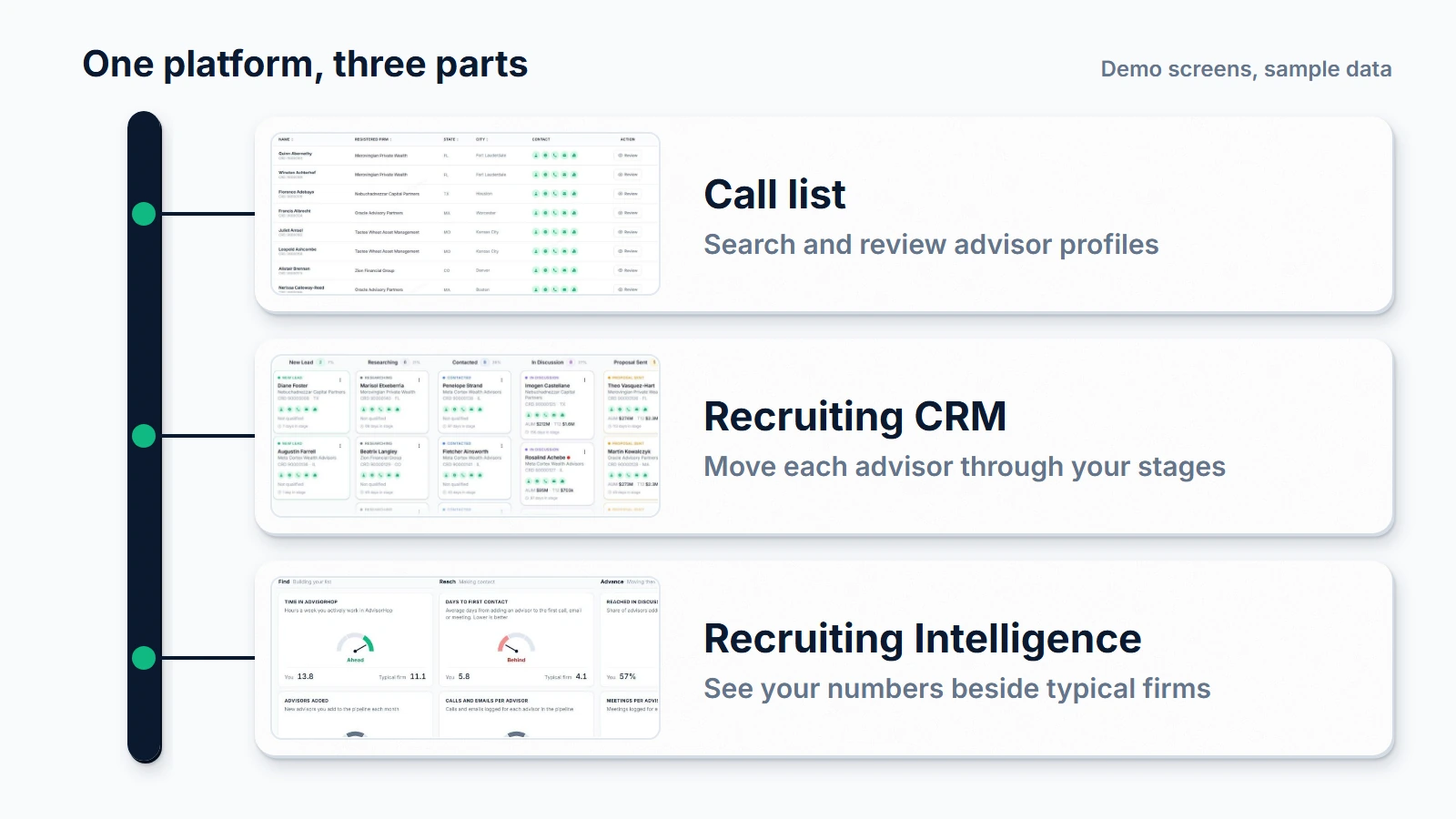
AdvisorHop is built for that second path. The Discovery List comes pre-loaded with hundreds of thousands of advisor profiles from independent BDs, RIAs, and hybrid firms, with bios, credentials, and direct dials where available, so there is nothing to import before your first call. The recruiting CRM has pipeline stages built for advisor recruiting, a timeline on every advisor, and follow-up reminders. Recruiting Intelligence shows advisor moves, firm and segment changes, weekly recruiting news, and your own find, reach, advance, and close numbers. Standard is $250 per month, and AdvisorHop is free during the beta. See how it works for a walkthrough.
When does a search firm still make sense?
Do not treat agencies as the enemy. Bring one in when:
- You need a senior or niche hire your network and list cannot reach quickly.
- You are pursuing a team lift-out that needs discreet, multi-party coordination.
- Your principals cannot spare the weekly dial time and you need temporary capacity.
- The role is sensitive enough that a confidential intermediary helps both sides talk.
- You already have a trusted recruiter relationship and a clear fee agreement.
A healthy mix for many firms: run the ongoing pipeline in-house, and keep search partners for exceptional seats. If you are comparing agencies, our directory of financial advisor recruiting firms is a good starting point. Read any recruiter agreement closely, including how long an introduced candidate stays covered, and ask your counsel about it. This is general information, not legal advice.
How do you compare cost per hire with a placement fee?
Use the same 12-month window for every path:
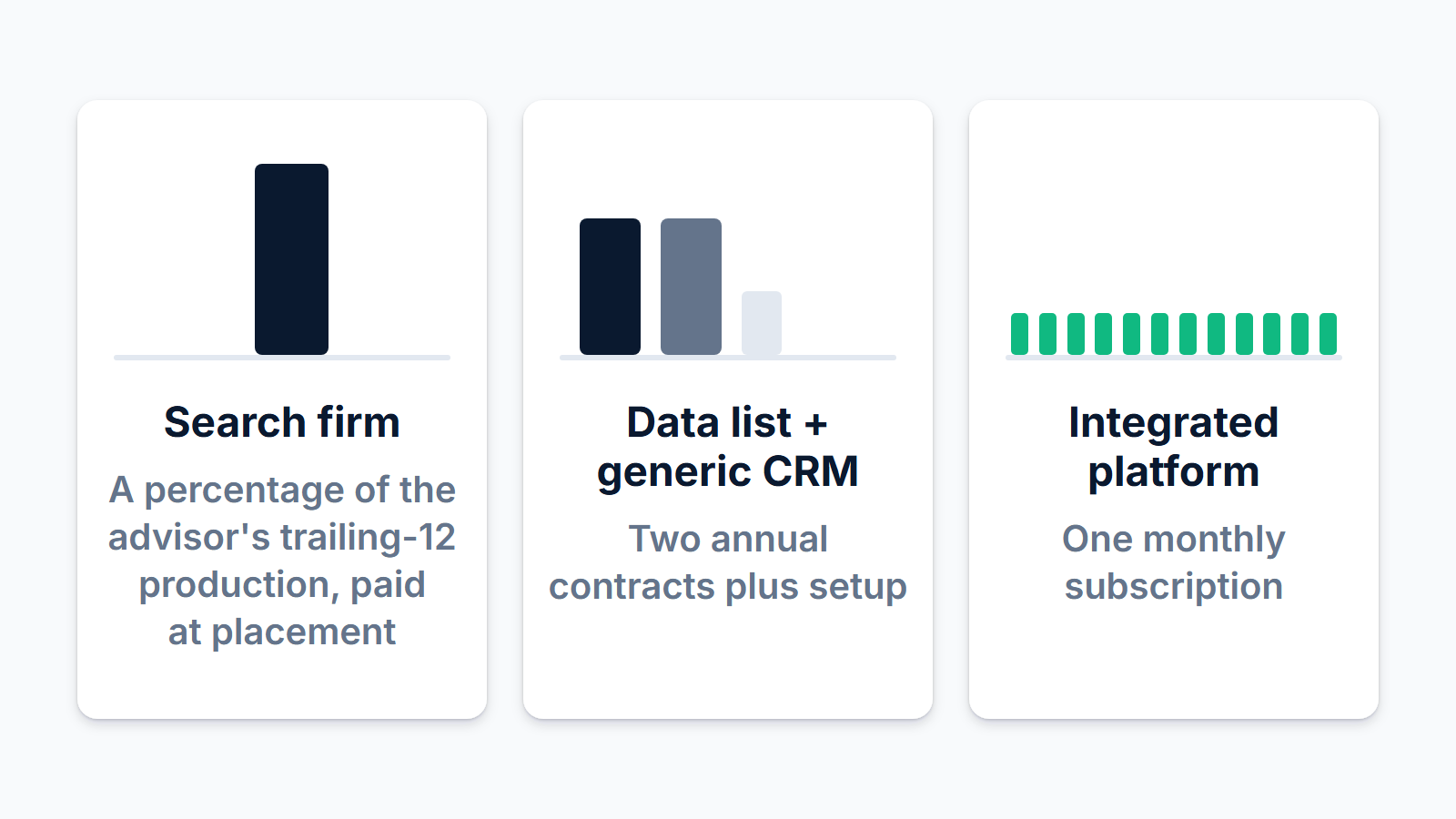
- Search firm: the placement fee as a percentage of the advisor's T12 production, plus your team's time on interviews and the close.
- Data list plus generic CRM: annual software for both tools, plus setup and the time to keep the list current.
- Integrated recruiting platform: a subscription instead of a per-placement fee, plus your team's time. At AdvisorHop's Standard price of $250 per month, that is $3,000 a year, and it does not grow with each additional hire.
Then put your own funnel numbers beside the cost. If one in-house hire costs less than one placement fee, and the desk keeps working the pipeline afterward, the case builds with every additional hire. If your team cannot spare the weekly time, a search firm may be the better value for that seat.
FAQ
How do you recruit financial advisors without a search firm?
Define the ideal recruit, work a living call list, prioritize with practical signals, run a steady outreach cadence, hold structured discovery and model-fit meetings, and track every stage in a recruiting pipeline. Measure cost per hire against what a placement fee would have been.
What does it cost to recruit financial advisors in-house?
Mostly your team's time plus tools. A stitched data list and general-purpose CRM often runs roughly $8,000 to $25,000+ per year combined, and a recruiting platform is typically a flat subscription (AdvisorHop Standard is $250 per month, and free during the beta). Search firms typically charge 8-12% of an advisor's trailing-12-month production per placement.
Is in-house recruiting better than using a recruiter?
Neither is universally better. In-house wins on relationship ownership, recurring cost, and control of the pipeline. A search firm still makes sense for scarce senior talent, team lift-outs, or when your leaders cannot run a weekly desk.
What tools do I need to recruit advisors myself?
A current call list, a recruiting pipeline with stages, notes, and follow-ups, and a way to prioritize who to work next. That can be three separate products, or one platform that combines a living list, a recruiting CRM, and recruiting signals.
How long does it take to recruit a financial advisor?
Often months, not weeks. Experienced producers move carefully, and discovery, diligence, and transition planning all add time. A living pipeline matters because today's "not now" can become next quarter's hire.
Can a small RIA, IBD, or OSJ run this without a full recruiting team?
Yes, if the process is simple and the tools do not require a data-import project. Many desks are one principal or BD lead with a few focused hours a week. Start with a tight definition of the ideal recruit and a short weekly cadence rather than trying to do everything at once.