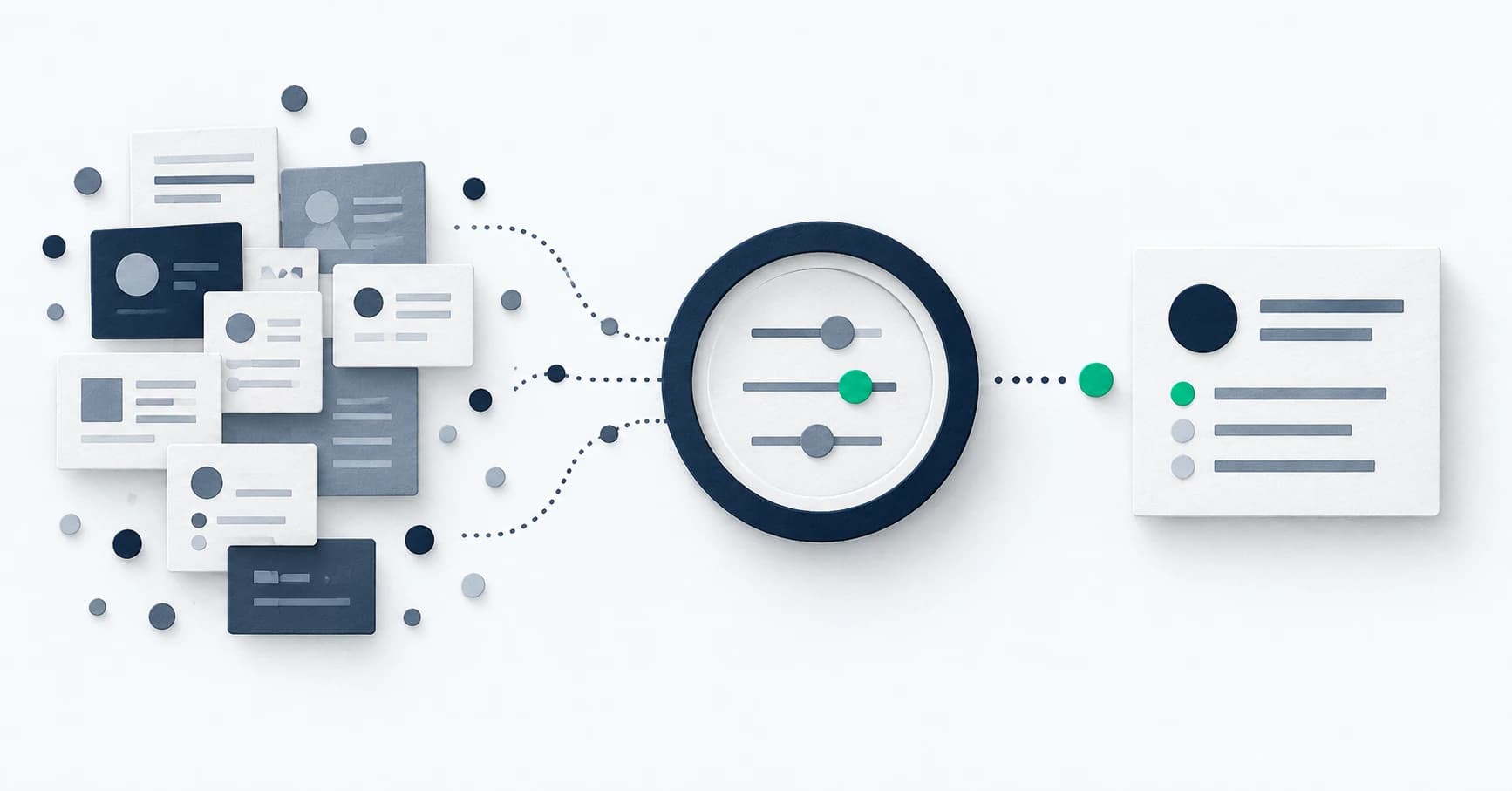
Advisor recruiting intelligence is the layer that turns advisor data into a next action — who moved recently, which firms are growing. If you search for the term, you'll find wealth-data platforms, AI sourcing tools, and vendor blogs about "signals." What's harder to find is a plain answer for the person who actually has to fill an RIA, hybrid, IBD, or OSJ recruiting desk: what is this category, and what do you actually need day to day?
A spreadsheet of names is not intelligence. Neither is a generic CRM built for client households. This post defines the category fairly, names who else shows up in it, and shows where a list-only or intel-only stack falls short for an in-house desk.
Recruiting intelligence vs. advisor data vs. AI sourcing: what's the difference?
Three things get mixed up in the same search results:
Advisor data / databases Firm and advisor records, often aimed at distribution teams calling on RIAs as well as (sometimes) recruiting. Services like this are often strong at coverage and firm attributes. Used alone, they may leave a recruiting desk still needing a pipeline, a dialer workflow, and a focused way to decide where to start. Names that may appear in "best RIA database" guides include FINTRX, AdvizorPro, Dakota, ISS Market Intelligence, and RIA Database.
Call lists / contacts Phone- and email-oriented lists for outreach. Useful when records are fresh and callable. A static export goes stale; a living, continuously refreshed list is different. Services in this category often lead with contact lists and outreach features.
AI sourcing / recruiting OS Tools that emphasize sourcing, sequencing, or an "operating system" for recruiting teams. Tools in this category generally focus on workflow or AI-assisted outreach. AdvisorHop puts a pre-loaded, continuously refreshed call list, the recruiting CRM and intelligence in one seat. Names you may see in this category include Noon and HNTR AI. Our guide to recruiting software walks through the fuller comparison.
Recruiting intelligence (the useful definition) For an in-house desk, recruiting intelligence means using movement and firm context to decide who to work, inside a recruiting pipeline. Signals without a place to log calls and stages become slideware. A CRM without a callable universe becomes busywork. Intelligence belongs with the list and the recruiting CRM — not as a third, orphaned login.
What signals do recruiting desks actually act on?
Skip vanity dashboards. Desks act on a short list of practical cues.
Movement, breakaway, and tenure patterns
Public and industry narratives about advisors changing firms — or looking ready to — are a real part of this category (data providers often publish explainers on the topic, such as this one on breakaway advisors). Treat signals as hypotheses to test on a call, not as guarantees. This section describes the category, not a specific AdvisorHop feature.
Fit and focus
The job isn't "more names." It's a focused short list: right channel (RIA / hybrid / IBD), right seniority, right geography, plus context on recent moves and firm activity. That's workflow intelligence, not another BI tool for leadership decks. As above, this describes the category, not a specific AdvisorHop feature.
Who shows up in the advisor recruiting intelligence category today?
You'll see different products depending on the query:
| Category | What the category generally does |
|---|---|
| Advisor data and database services | Data depth and coverage |
| Contact-focused list services | Contact lists for outreach |
| AI sourcing / recruiting OS tools | Workflow or AI-assisted outreach |
| Recruiting firms / agencies | Human search, relationship-driven placements |
Names you may see across these categories include FINTRX, AdvizorPro, Dakota, ISS Market Intelligence, RIA Database, Altss, RIA Pulse, Fiducia, Noon and HNTR AI. An in-house desk may also want the list, a recruiting CRM and intelligence in one place.
AdvisorHop's job isn't to pretend those products don't exist. It's to bring the list, the recruiting CRM, and recruiting intelligence together for firms that recruit advisors themselves.
What does it cost to stitch this together yourself?
Stacks that fail in practice often look like this:
- Buy a database or list export
- Dump it into a generic CRM (or spreadsheets)
- Subscribe to a "signals" feed in a third tab
Each piece can be excellent on its own. Together they're slow, expensive, and inconsistent: stale phone numbers, pipeline stages that don't match recruiting, and signals that never become dials. Enterprise-grade data subscriptions can be a significant annual line item on their own, before CRM and process are added on top. That's before accounting for what firms already pay to source advisors the traditional way: third-party recruiters typically charge about 8–12% of an advisor's trailing production, and that range has been rising. On $250K of trailing production, that's roughly $20,000–$30,000. Some recruiters charge a monthly retainer plus a success fee that still totals about 8–12%. Our full ROI breakdown walks through that math in detail.
How does AdvisorHop combine the list, the CRM, and the intelligence?
AdvisorHop is built as one platform for in-house advisor recruiting:
- Pre-loaded call list — Financial advisor profiles that are enriched, continuously refreshed and updated, not a one-time CSV.
- Purpose-built recruiting CRM — Pipeline stages, notes, follow-up reminders, and qualification fields for AUM, production and payout, not a client-household CRM.
- Recruiting Intelligence — Movement, industry and firm views, for your own firm and about the industry, tied to that same list and pipeline.
The pricing model is a flat subscription rather than an enterprise data contract stitched to a generic CRM seat, and it sits well below a single third-party placement fee.
Who is advisor recruiting intelligence for?
- RIAs and hybrid RIAs building a bench without a full retained search
- IBDs and OSJs / branch leaders running in-house desks
- Teams tired of paying separately for "a list," "a CRM," and "intel"
If your job is calling on RIAs to distribute a fund, you may still want a distribution-first database. If your job is recruiting advisors onto your platform, you want the recruiting-desk stack.
FAQ
What is advisor recruiting intelligence?
Software and workflows that help a recruiting desk focus on movement and firm context — ideally inside the same system as the call list and pipeline, rather than a separate login.
Do I still need a recruiter?
Sometimes. Software doesn't replace relationships or complex transitions. It replaces starting from zero, working stale lists, and paying enterprise data-plus-CRM rates just to dial.
Is this a client CRM?
No. Client CRMs generally optimize households and advice workflows. A recruiting CRM optimizes advisor candidates and a hiring pipeline — a different job with a different search intent.
How is AdvisorHop different from a list or a database?
A database or call list is one pillar. AdvisorHop combines the list, a recruiting CRM, and recruiting intelligence in one place.
What makes an advisor "callable," and how does that relate to recruiting intelligence?
A callable advisor is one with a contact path on the profile and the right segment fit. Recruiting intelligence builds on that baseline — it's the layer that adds movement and firm context on top of that baseline.