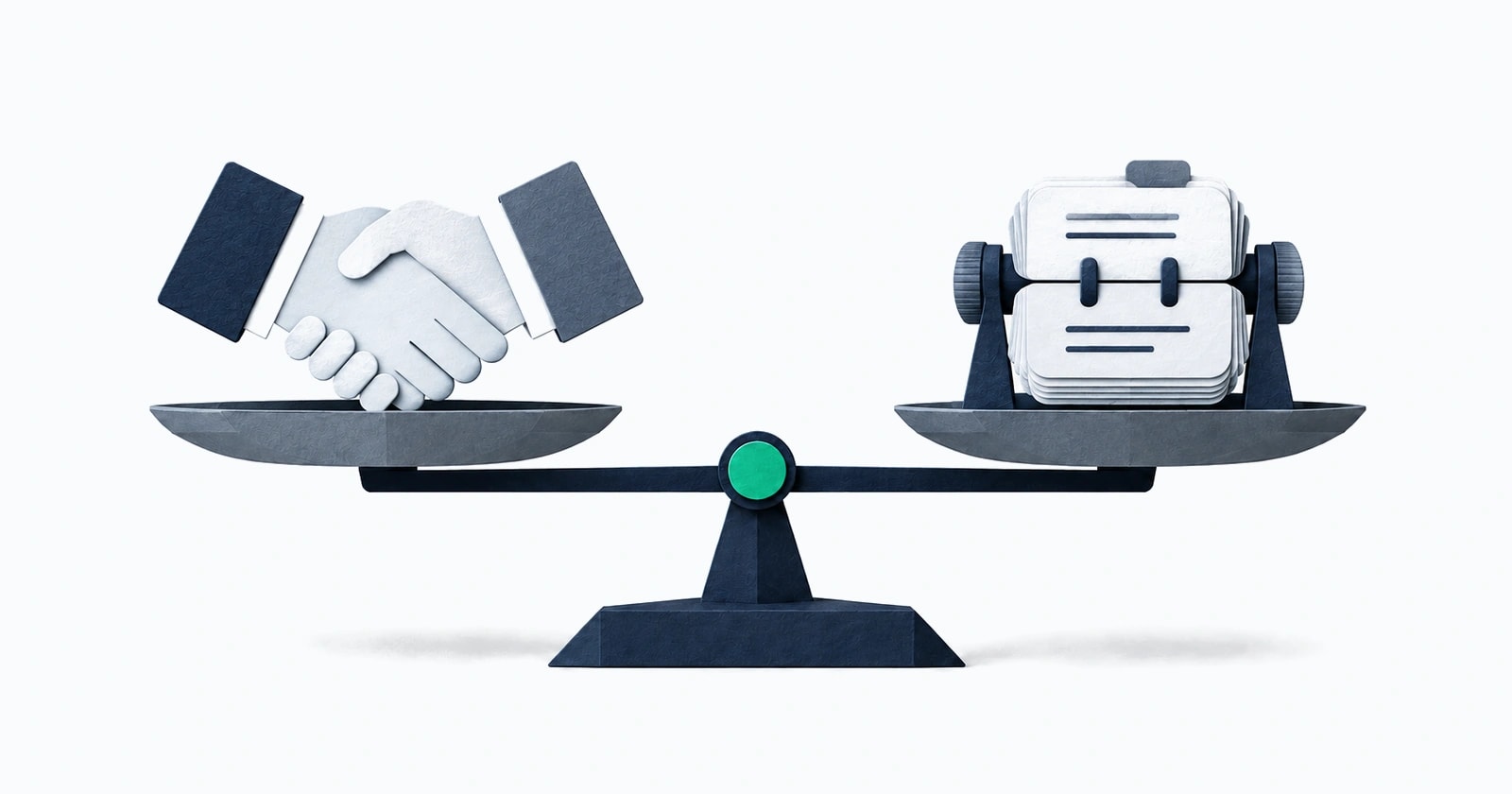
Whether to contract with a third-party financial advisor recruiter or recruit in-house depends on four things: how many advisors you want to add each year, how urgent the seat is, how confidential the target is, and whether someone at your firm has real hours each week to make calls. Use a recruiter for rare, urgent, or confidential seats. Build an in-house desk if you recruit repeatedly and can protect weekly calling time. Many firms do both.
AdvisorHop is one recruiting platform (a call list, a recruiting CRM, and Recruiting Intelligence) for firms that want to run the in-house path. This guide is for RIA principals, independent broker-dealer (IBD) leaders, office of supervisory jurisdiction (OSJ) heads, and small recruiting desks choosing between paying a recruiter, building a desk, or mixing the two.
Which path fits you?
Here is the choice at a glance. Each row is a tendency, not a rule, and your own situation can break the pattern.
The same comparison as a shareable image. General tendencies, not rules.
Third-party recruiters typically charge 8% to 12% of an advisor's trailing-12-month production per placement, with exact terms varying by firm and placement. Our cost-of-recruiting breakdown works through what that looks like in practice.
What seven questions decide it?
Answer these honestly, in order. Many firms land clearly on one side by question five.
- How many advisors do you want to add in the next twelve months? One or two favors a recruiter on the hard seats. Several favors a desk, because a per-placement fee repeats with every placement while a subscription does not.
- Do you already know who you want? If you have a short list and a reason to call each person, an introduction adds less. If you have no list, a recruiter's network is worth more.
- How urgent is the seat? If you need a producer in a specific market soon, a recruiter with existing relationships may be faster than starting a calling cadence from zero.
- Does the advisor need a go-between? An advisor who cannot be seen talking to your firm may only take a first call from a third party.
- Who will make the calls, and for how many hours a week? This question often decides it. A desk with no protected calling time is a plan, not a desk.
- How much of the process do you want to own? In-house means your team owns the pitch, the follow-up, and the notes. A recruiter means sharing some of that.
- What happens to what you learn? Every conversation teaches you something about the market and about your own pitch. Ask where that knowledge lives when the search ends.
When is a recruiter the better call?
A recruiter is a good fit for some seats, and a fair comparison says so.
- The seat is rare or senior. A specific producer, a team lift-out, or a leader for a new office is a different job from filling a general growth target.
- The target is confidential. A recruiter can open a discreet first conversation.
- You have no bandwidth. If no one at your firm can protect a few hours a week, outside capacity is worth paying for.
- You need the advisor's side of the market. An experienced recruiter has watched many transition packages and can help both sides understand what is typical.
- You recruit rarely. If you add one advisor every couple of years, a per-placement fee may be the cheapest way to get a good result.
If a seat calls for a third-party recruiter, our directory of financial advisor recruiting firms is a place to start.
When is in-house the better call?
In-house tends to fit when the following are true.
- You recruit repeatedly. The demand is not going away. Schwab's 2025 RIA Benchmarking Study, as reported by InvestmentNews in July 2025, estimated the RIA industry will need to add over 70,000 new staff over the next five years. That covers every role, not only advisors, but it points to steady demand for talent.
- You are competing with firms like yours. In a Cerulli analysis reported by Financial Planning in November 2023, the number of advisors at independent RIAs grew at a 5.2% compound annual rate over the prior decade, while the number of independent RIA firms grew at 2.4%. More advisors per firm often means more firms recruiting from the same pool.
- Succession is on your mind. Cerulli's 3Q 2026 advisor report, as covered by PlanAdviser in August 2026, said about 35.3% of advisers expect to retire within 10 years. A firm that builds relationships early is better placed when an advisor starts thinking about what comes next.
- You want the history to stay. Every note, every call, and every follow-up stays in your pipeline, whoever on your team made it.
- You have a person with focused hours. A steady weekly cadence beats an occasional burst.
Our guide to recruiting financial advisors in-house lays out the desk step by step, and the how-to-recruit overview covers the basics.
What does a hybrid look like?
A hybrid is a common answer, and it is not a compromise. It is a division of labor.
- The desk runs the steady pipeline. Your team works the call list, keeps notes, and follows up on a regular rhythm.
- A recruiter handles the exceptions. A senior seat, a confidential approach, or a team move goes to a third-party recruiter on terms you negotiate.
- The two share a rule. Decide in advance which seats go where, and write down how you handle an advisor already in your pipeline whom a recruiter also introduces. Clarify this before the first introduction. This is general information, not legal advice. Consult counsel on any agreement you sign.
For independent broker-dealer (IBD) leaders. The same choice applies across a network of affiliated advisors. An IBD that recruits for its branches often has little protected calling time at any one branch, so a third-party recruiter can fit a rare seat while the home office or a branch desk runs the steady pipeline. Before the first introduction, decide who owns the relationship with an advisor already in the firm's pipeline, and write down how the home office, the branch and any recruiter share the work. Bring compliance in early, because supervisory and registration requirements shape how an advisor joins an independent broker-dealer.
What does an in-house desk need?
At minimum, four things, described here in general terms.
- Leads. Introductions to advisors who may be thinking about a move. They come from referrals and word of mouth, events and networking, advisors finding you through your content, an industry list you buy or license, and introductions from your own advisors and custodians. Expect to work at it; leads do not arrive on their own.
- A call list. Someone has to know who the advisors are. The AdvisorHop Discovery List is a pre-loaded call list with over 400,000 advisor profiles and growing, a living list that is continually refreshed, with profiles enriched over time through publicly available sources, third-party vendors, and proprietary AI-powered technology.
- A recruiting CRM. You need a way to track and follow up with every lead: who you called, what they said, what you promised, and when to follow up. A general-purpose tool can store contacts, but a pipeline built for advisor recruiting keeps the stages, timeline, and reminders in one place for your whole desk.
- Recruiting Intelligence. Firm-level and industry-level views that help the desk decide who to call and when.
All three sit in one platform. AdvisorHop Standard is $250 per month for one seat, and a Teams plan is available for more seats. The platform is free during the beta with no credit card. See how it works and pricing.
What is a simple 90-day test?
If you cannot decide, run a short experiment before committing to either side.
- Pick one target segment. For example, advisors at a type of firm or in a region that fits your pitch.
- Set a calling cadence. Choose a number of hours per week that someone will protect, and write it down.
- Log every conversation. Record who you called, what they said, and what the next step is.
- Decide your measures up front. Track conversations held, follow-ups scheduled, and advisors who agreed to a second meeting. Do not promise yourself a placement.
- Review at day 90. If the desk is producing real second meetings, keep building it. If calls keep getting dropped for other work, that is a signal to pay a recruiter for the seats that matter.
- Decide the split. Write down which seats stay in-house and which go to a recruiter, then revisit it each quarter.
FAQ
Is it cheaper to recruit financial advisors in-house?
It can be if you recruit repeatedly, because a subscription and staff time are spread over every advisor you add, while a placement fee repeats with each one. If you recruit rarely or cannot protect calling time, a recruiter may be the better value. The two are not like for like, and neither guarantees a placement.
When should I contract with a third-party financial advisor recruiter?
Consider a recruiter for rare or senior seats, confidential targets, urgent searches, and times when no one on your team has hours to make calls. Read the terms before you sign, including the percentage, the base, payment timing, any guarantee, and how long introduced advisors stay covered. This is general information, not legal advice. Consult counsel.
Can a small firm recruit advisors without a recruiter?
Yes, if it has a current call list, a pipeline, and someone with a few focused hours each week. Some seats may still call for outside help.
Can I use both a recruiter and an in-house desk?
Yes. Many firms run the steady pipeline in-house and keep a recruiter for hard seats. Decide in advance which seats go where and how you handle an advisor who appears in both places.
How do I compare financial advisor recruiters?
Compare the fee percentage and what it is based on, payment timing, the guarantee, how long introduced advisors stay covered, exclusivity, and how well the recruiter knows your segment. Ask for the terms in writing. Our directory of financial advisor recruiting firms is a starting list.
What does an in-house recruiting desk need to start?
A steady source of leads (referrals, events, content, an industry list), a call list, a recruiting CRM to track and follow up on every lead, a view of the market, and one person with protected weekly hours. A platform such as AdvisorHop brings the call list, the CRM and the market view together.